
Tesla charging estimate (UK): real overnight home charging costs
Want a realistic Tesla charging estimate for UK home charging — not lab range figures? This guide uses a real-world example on a standard 3-pin plug (10A) with an off-peak EV tariff to show how much battery and range you can add overnight, and what it typically costs.
Quick answer: overnight Tesla charge estimate
If you’re charging a Tesla at home in the UK on a standard 3-pin plug (10A), a simple real-world rule of thumb is: around 3% battery per hour. Over a 6-hour off-peak window, that’s roughly 18% — typically around 50–60 miles of added range.
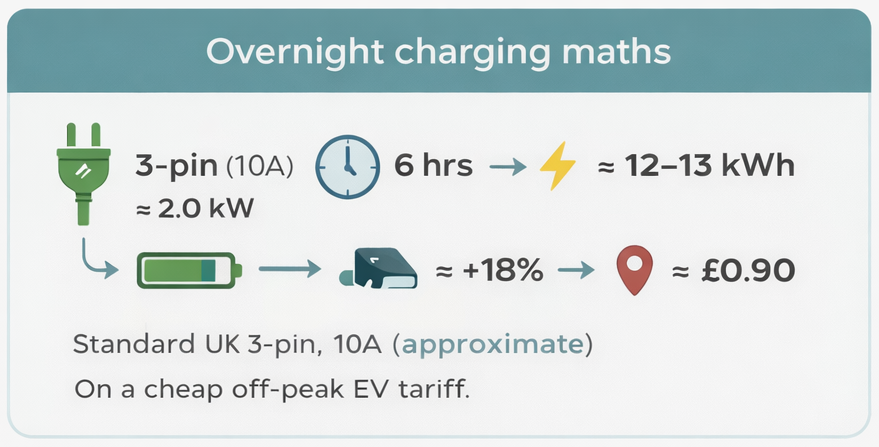
| Overnight charging (example) | Result |
|---|---|
| Charging setup | 3-pin plug (10A), ~2.0 kW |
| Charging time | ~6 hours (off-peak) |
| Energy added | ~13 kWh |
| Battery increase | ~18% |
| Range added | ~55 miles |
| Typical cost (off-peak) | ~£0.90 |
Real example: Tesla Model Y overnight charging (3-pin, 10A)
Here’s a realistic UK home-charging setup and outcome based on a Tesla Model Y Long Range (2022) using a standard 3-pin plug. Exact results vary by temperature and starting state of charge — but this is a useful baseline for expectations.
Setup
- Connector: 3-pin plug (10A) “granny” charging
- Power: ~2.0 kW
- Charging window: ~6 hours overnight
- Tariff: off-peak EV rate (typical cheap window)
Result (typical)
- Energy added: ~13 kWh
- Battery gain: ~18%
- Range added: ~55 miles
- Rate: ~3% per hour (≈ 9 miles/hour)
What this means
- Perfect for daily top-ups and predictable costs.
- Most savings come from when you charge (tariff window), not just charger power.
- If you can reliably plug in overnight, you’re usually winning.
How much does it cost to charge a Tesla overnight?
Cost is mostly energy (kWh) × your unit rate. In the real example above, an overnight top-up adds around 13 kWh. On a cheap off-peak rate (around 7p/kWh), that’s typically about £0.90.
How long does it take to charge a Tesla at home?
On a 3-pin 10A setup, a handy planning shortcut is about 3% battery per hour. That means charging time (hours) ≈ (Target % − Current %) ÷ 3.
+10%
~3–4 hours (typical)
+20%
~6–7 hours (typical)
+30%
~9–10 hours (typical)
+40%
~12–13 hours (typical)
Is a 3-pin plug “enough” for a Tesla?
For many UK drivers, yes — especially if you can plug in most nights. A 3-pin plug is best for steady overnight top-ups and lower daily mileage. If you routinely need big refills (or can’t reliably plug in), a 7kW home charger makes life easier.
How to improve your Tesla charging results
1) Hit the cheap window
Most savings come from charging during off-peak hours. If you miss the window, costs jump fast. See which suppliers currently offer the best cheap windows on our cheapest EV tariffs page.
2) Precondition sensibly
Cold weather reduces efficiency. If you preheat the cabin, do it while plugged in where possible.
3) Avoid weak extensions
For 3-pin charging, use a healthy socket and avoid long, coiled, or cheap extension leads. If an extension is unavoidable, it should be heavy-duty, fully uncoiled, and regularly checked for heat.
Estimate your own cost with our calculator
Want a personalised Tesla charging estimate based on your mileage and tariff? Use our tools: quick calculator for a fast answer, or the tariff comparison table to compare suppliers.
Run your numbers
Estimate what you’ll pay per month on different tariffs based on your driving.
Use quick calculator →FAQ (Tesla charging estimate)
How much does it cost to charge a Tesla at home in the UK?
It depends on your tariff. A common real-world overnight top-up might be around 10–15 kWh. On a cheap off-peak EV rate, that can be under £1; on a standard rate it may be several pounds for the same energy.
How many miles can a Tesla gain overnight on a 3-pin plug?
A typical 6-hour overnight session on 10A can add roughly 50–60 miles, depending on temperature and efficiency.
Is a wall charger worth it?
If you want faster “catch-up” charging, more flexibility, or you often arrive home low on battery, a 7kW charger usually improves convenience. If you can plug in nightly and your mileage is modest, 3-pin can still work.
Why does my Tesla charge slower in winter?
Cold batteries are less efficient and the car may use energy for battery conditioning and cabin heating. That can reduce how many miles you gain per hour of charging.
Estimates are based on typical UK home charging and a real-world example. Your results vary by temperature, starting state of charge, driving efficiency and tariff terms. Always confirm live regional unit rates and standing charges with your supplier.